Chapter 12. Reflection
1. Rule to find the reflection of a point in the x-axis:
(1) Retain the abscissa i.e. x-co-ordinate.
(2) Change the sign of ordinate i.e. y co-
ordinate.
2. Rule to find the reflection of a point in the y-axis:
(1) Change the sign of abscissa i.e., x-co-ordinate.
(ii) Retain the ordinate i.e., y-co-ordinate.
3. Reflection of a point in a line parallel to x
axis: The reflection of the point P (x, y) in
the line y=a is the point P (x,-y + 2a).
4. Reflection of a point in a line parallel to y
axis: The reflection of the point P (x, y) in
the line x-a is the point P (-x+ 2a, y).
5. Reflection of a point in the origin:
(1) Change the sign of abscissa i.e., x-co ordinate.
(ii) Change the sign of ordinate i.e.. y-co ordinate.
6. A point is called an invariant point with
respect to a given line if and only if it lies
on the line after reflection in the same line.
Chapter 15. Circles
1. A straight line drawn from the centre of the circle to bisect a chord, which is not a diameter, is at right angles to the chord. Conversely, the perpendicular to a chord,
from the Centre of the circle, bisects the chord.
2. There is one circle, and only one, which
passes through three given points not in a straight line.
3. Equal chords of a circle are equidistant
from the Centre.
Conversely, chords of a circle, equidistant from the Centre of the circle, are equal.
4. The angle which an arc of a circle subtends at the Centre is double, that
which it subtends at any point on the
remaining part of the circumference.
5. Angles in the same segment of a circle are equal.
6. The angle in a semicircle is a right angle.
7. In equal circles (or, in the same circle), if two arcs subtends equal angles at the Centre, they are equal.
Conversely, in equal circles (or, in the same circle), if two arcs are equal, they subtend equal angles at the Centre.
8. In equal circles (or, in the same circle), if two chord are equal, they cut off equal arcs. Conversely, in equal circle (or, in the same circle. if two arcs are equal the chords of arcs are also equal.
9. The opposite angles of a cyclic quadrilateral (quadrilateral inscribed in a circle) are supplementary
10. The exterior angle of a cyclic quadrilateral is equal to the opposite interior angle
11. The tangent at any point of a circle and the radius through this point are perpendicular to each other
12. If two circles touch each other, the point of contact lies on the straight line through the centers.
13. From any point outside a circle two tangents can be drawn and they are equal in length.
14. If a chord and a tangent intersect externally, then the product of the lengths of segments of the chord is equal to the square of the length of the tangent from the point of contact to the point of intersection.
15. If a line touches a circle and from the point of contact, a chord is drawn, the angles between the tangent and the chord are respectively equal to the angles in the corresponding alternate segments.
16. If two chords intersect internally or externally then the product of the lengths of the segments are equal.
Chapter 17. Mensuration
1. PERIMETER:
Perimeter of a plane figure = sum of lengths of its sides.
2. SURFACE AREA AND VOLUME OF SOLIDS :
Solid Cylinder :
Let r and h be the radius and height of a solid cylinder, then
1. Curved (Lateral) Surface Area = 2πrh
2. Total Surface Area = 2πr(h+r)
3. Volume = πr^2h
Hollow Cylinder :
Let R and r be the external and internal radius and h be the height of a solid cylinder, then
1. External Curved Surface Area = 2πRh
2. Internal Curved Surface Area = 2πrh
3. Total Surface Area = 2π(Rh + rh + R^2 - r^2).
4. Volume = π(R^2 - r^2)h
Cone :
Let r and h be the radius and height, and l be the slant height of the cone, then
1. Curved Surface Area = πrl
2. Total Surface Area = πr(l + r)
3. Volume = 1/3*πrh
Chapter 18. Trigonometry

.png)

Chapter 19. Statistics
1. Mean :
(a) Mean (for ungrouped data) = Sum of X/n
Where X1, X2, X3, ......,Xn are the observations and n is the total number of observations.
(b) Mean (for grouped data) = Sum of F*X/Sum of F
Where X1, X2, X3, ......, Xn are different varities with frequencies F1, F2, F3, ....., Fn respectively.
(c) Mean for continuous distribution.
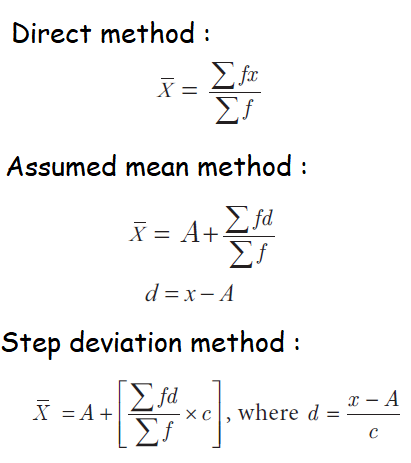
2. Median and Quartiles :

Chapter 20. Probability
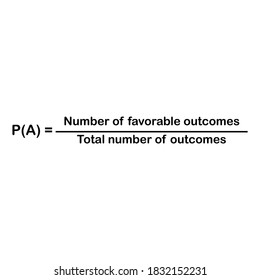
1. If all the outcomes of an experiment are equally likely and E is an event, then probability of event E, written by P(E), is given by
3. P(not E) = 1 - P(E)
4. P(E) = 1 - P(not E)
5. P(E) + P(not E) = 1
6. The sum of the probabilities of all the elementary events of an experiment = 1
7. The Probability of a sure event = 1
8. The Probability of an impossible event = 0


Weird Formula bruh ��
ReplyDeleteThanks...
ReplyDeleteLove for uuhh...
Thanks for helping us..❣️
How Can I Download This Pdf
ReplyDelete